

 Cusco
South Valley Tour in Cusco (Half a Day)
This tour is renowned for its captivating blend of stunning natural landscapes, Inca architecture at Tipón,...


We will begin our adventure with hotel pick-up. We will depart at 5:00 a.m., and after approximately 3 hours, we will arrive at the community of Combapata, where we will stop to use the restroom facilities and enjoy breakfast.
We will then head to the Combapata viewpoint, where we can admire a panoramic view of the confluence of the Vilcanota and Sallca Rivers.
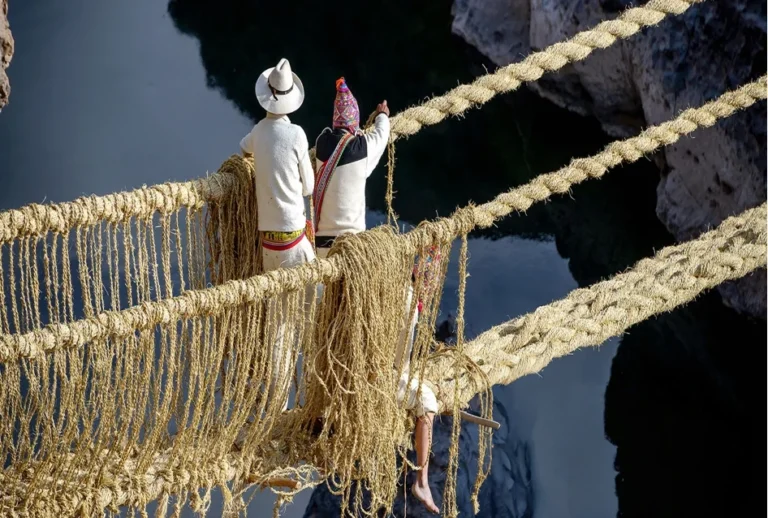
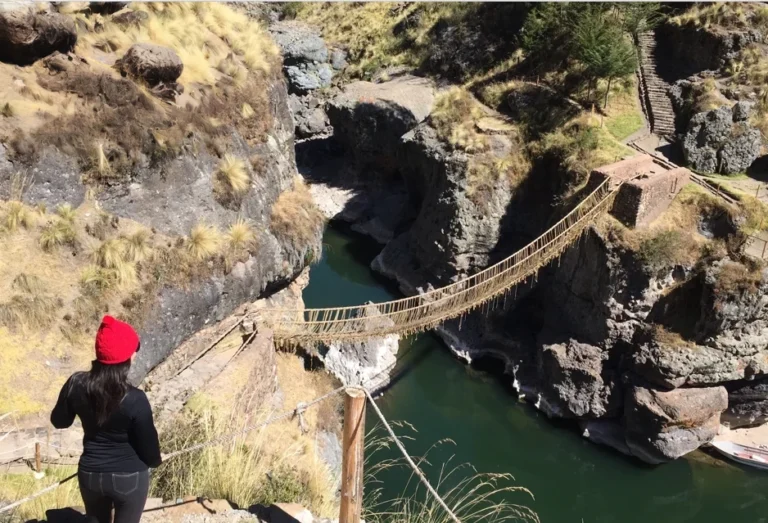
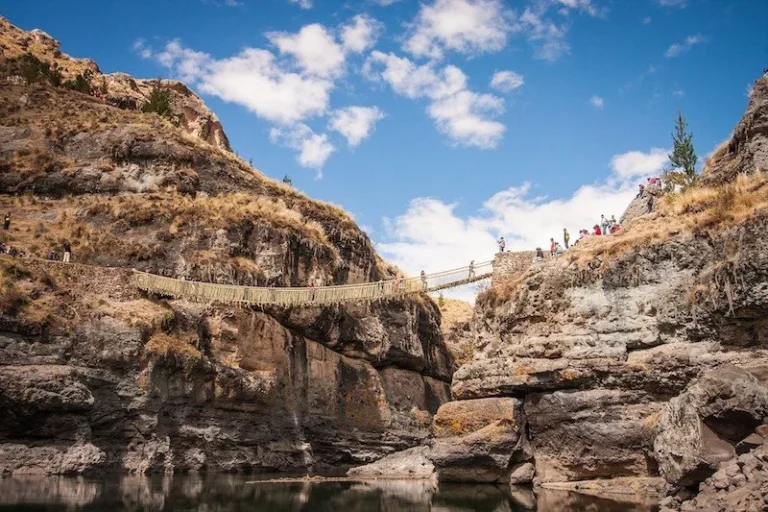
Continuing our journey, we will visit the Pabellones Volcano in the district of Yanaoca. After another hour of travel, we will arrive in the district of Q’ewe, where the famous Inca bridge of Q’eswachaka is located. Built from plant fiber, the bridge measures 28.67 meters (94 feet) in length. What is truly remarkable is that it is rebuilt once a year in June by four local communities.
Here, we will have time to explore Q’eswachaka and the surrounding area while your guide shares the history of this remarkable example of Inca engineering.
After visiting the bridge, we will head to Combapata, where we will enjoy lunch.
After lunch, we will take a 15–20-minute leisurely walk, during which we will admire the Pampamarca, Asnacqocha, Acopía, and Pomacanchi Lakes. Along the way, we will have the opportunity to observe a wide variety of regional flora and fauna while experiencing the rich Andean culture.
On our return to Cusco, we will make an optional stop at the Portal de Rumipunku.
This tour can only be booked as a Private Tour.
| Group Tours vs. Private Tours | Group Tours | Private Tours |
|---|---|---|
| Group Size | Min. 1, Max. 19 | Min. 2 |
| Pick-Up Time | According to the itinerary | Can be arranged |
| Language | English and Spanish | Spanish, English, or Portuguese |
| Meals (Breakfast and Lunch) | Semi-buffet | Buffet |
| Tour Pace | Varies | At your own pace |
Scheduled Pick-Up
Guests are picked up from their hotel early in the morning according to the scheduled itinerary.
English and Spanish
The tour is conducted in both languages, one after the other.
Semi-Buffet
Includes buffet-style breakfast and lunch at restaurants, subject to availability.
Varied Pace
The tour proceeds according to the pace of the entire group, so there may be delays. The schedule is less flexible.
Flexible Pick-Up
Transportation can wait for you, and you can be picked up shortly before the tour begins.
Personalized
Choose between a Spanish-, English-, or Portuguese-speaking tour guide.
Buffet
Includes buffet breakfast and lunch at higher-category restaurants.
Your Own Pace
We can make additional stops, visit more places, or skip sites you have already visited.
Qeswachaka (in Quechua, Q’ichwachaka) is a rope bridge made from plant fiber (ichu) located in the district of Quehue, Canas Province, in the Cusco region. It is approximately three and a half hours from the city of Cusco, at an altitude of 3,700 meters (12,139 feet) above sea level, and crosses the Apurimac River. It forms part of the ancient Inca road network known as the Qhapaq Ñan. The bridge dates back to the Inca era, and its maintenance and renewal are carried out through a traditional ritual performed by the communities of Huinchiri, Chaupibanda, Ccollana Quehue, and Choccayhua.
During the Inca period, Quechua communities built suspension bridges using plant fibers to cross the rugged geography of the Andes and connect different communities. Q’eswachaka is the only Inca bridge that remains “alive” today, as it is rebuilt every year as part of its preservation.
The Q’eswachaka Bridge spans the Apurimac River and is approximately 29 meters (95 feet) long and 1.20 meters (4 feet) wide. Its structure is primarily made from long, braided strands of ichu grass.
Every year, during the second week of June, the Q’eswachaka Bridge is renewed in a vibrant celebration accompanied by traditional festivities and typical foods and drinks, including chicha. In this tradition, the men traditionally take part in the construction of the ropes, while the communities of Chaupibanda, Choccayhua, Huinchiri, and Ccollana Quehue come together to rebuild the bridge.
The work begins several days beforehand, when residents collect q’oya, a strong plant fiber used to construct the bridge. Once collected, it is left to dry for a day before being beaten with stones and soaked to strengthen it. After this process, the q’iswas are created by joining several strands of q’oya together to form a rope. Family members participate in preparing these materials.
Once the q’iswas are ready, everything is prepared for the bridge renewal. The process takes approximately three days and involves various traditional rituals and offerings to Pachamama (Mother Earth) and the Apus (sacred mountains)
Cusco
This tour is renowned for its captivating blend of stunning natural landscapes, Inca architecture at Tipón,...
 Cusco
During this fascinating tour, we will explore the Vilcanota mountain range and its impressive snow-capped peaks...
 Cusco
The Classic Sacred Valley tour is a full-day trip from Cusco through the Sacred Valley of...