

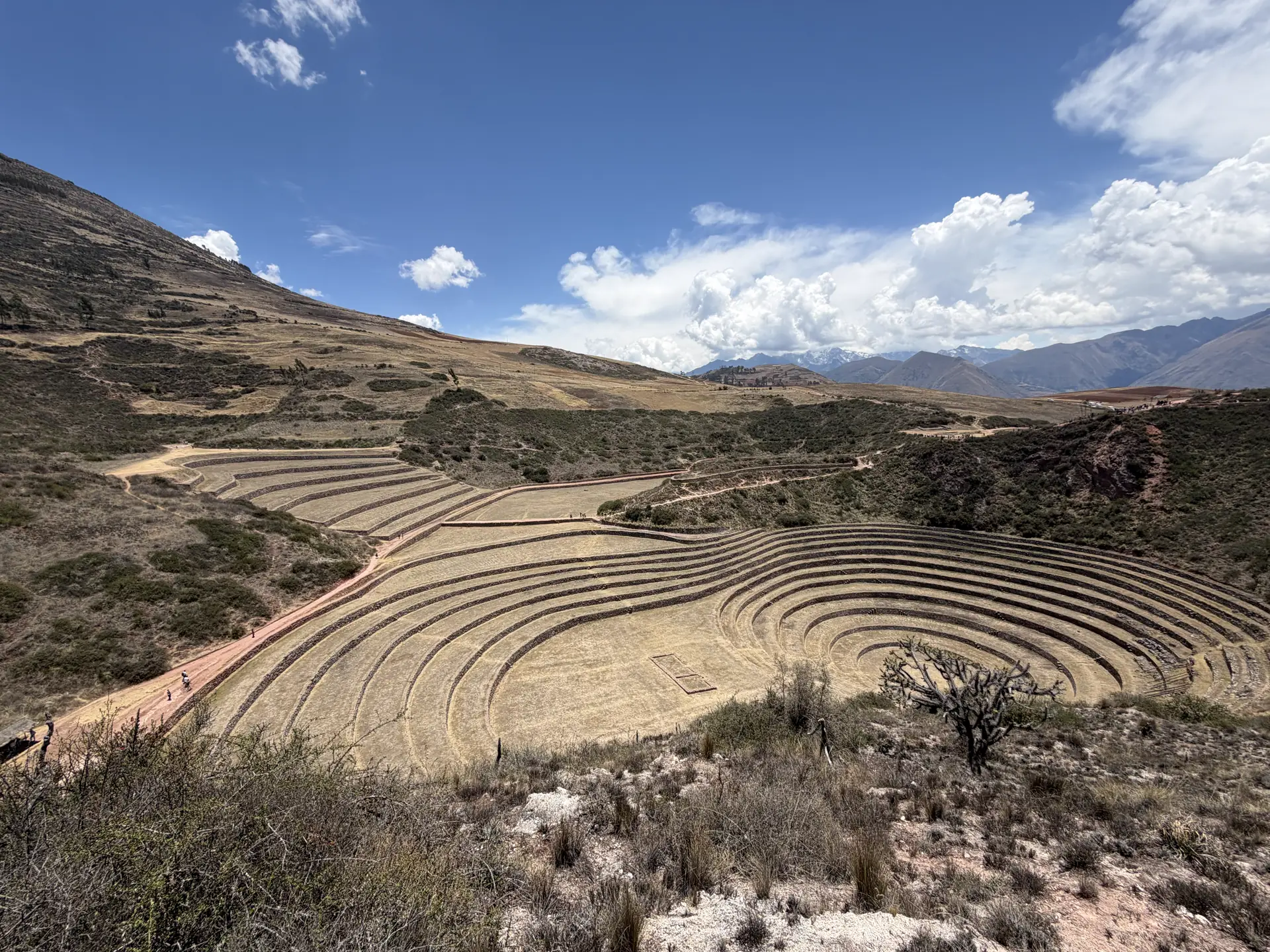
Maras is a town in the Sacred Valley, about 47 km from Cusco, and its district is home to two of the best-known sites in the valley. Moray consists of three large depressions with circular terraces that the Cusco Directorate of Culture describes as an Inca agricultural experimentation center. The Maras Salt Mines are some 4,500 salt pools on a hillside, which the communities of Maras and Pichingoto still work as they did in pre-Hispanic times. You can visit both in half a day. Moray is covered by the Cusco Tourist Ticket (Boleto Turístico); the Salt Mines have their own entrance fee. Here is what to see, tickets, opening hours and how to get there.
Data as of 22 October 2026. The official sources for every figure are listed at the end of the article.
- 773,916visitors to Moray in 2025
- 4,500salt pools, approximately, at the Maras Salt Mines
- 3,480 m · 3,200 maltitude of Moray and of the Salt Mines

Moray: the circular terraces
Moray lies in the community of Mullak’as Misminay, at about 3,480 m above sea level. It consists of three nearly circular depressions with concentric terraces that descend toward the center, like amphitheaters; the main one has twelve levels, connected by stairways, according to the MINCETUR tourism inventory.
The Decentralized Directorate of Culture of Cusco (DDC) describes it as an agricultural experimentation center intended to expand the frontier of cultivation by taking advantage of different ecological zones; according to the research cited by MINCETUR, temperature, humidity and microclimate change from one terrace to the next. The DDC adds that it may also have had a ceremonial function before being used to acclimatize crops, and MINCETUR notes that its specific function is still being researched. Its name is thought to come from the Quechua muyu (round) and uray (below), after the shape of its terraces.
It is Cultural Heritage of the Nation (National Directorial Resolution No. 406-2002) and one of the most visited sites in the country: it received 773,916 visitors in 2025, and in the first quarter of 2026 it was the second most visited archaeological site in Peru, after Machu Picchu, according to the Ministry of Culture.
Maras Salt Mines: some 4,500 salt pools
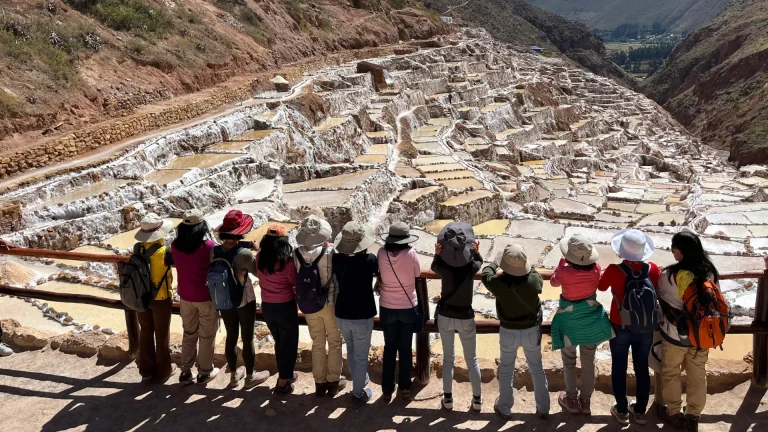
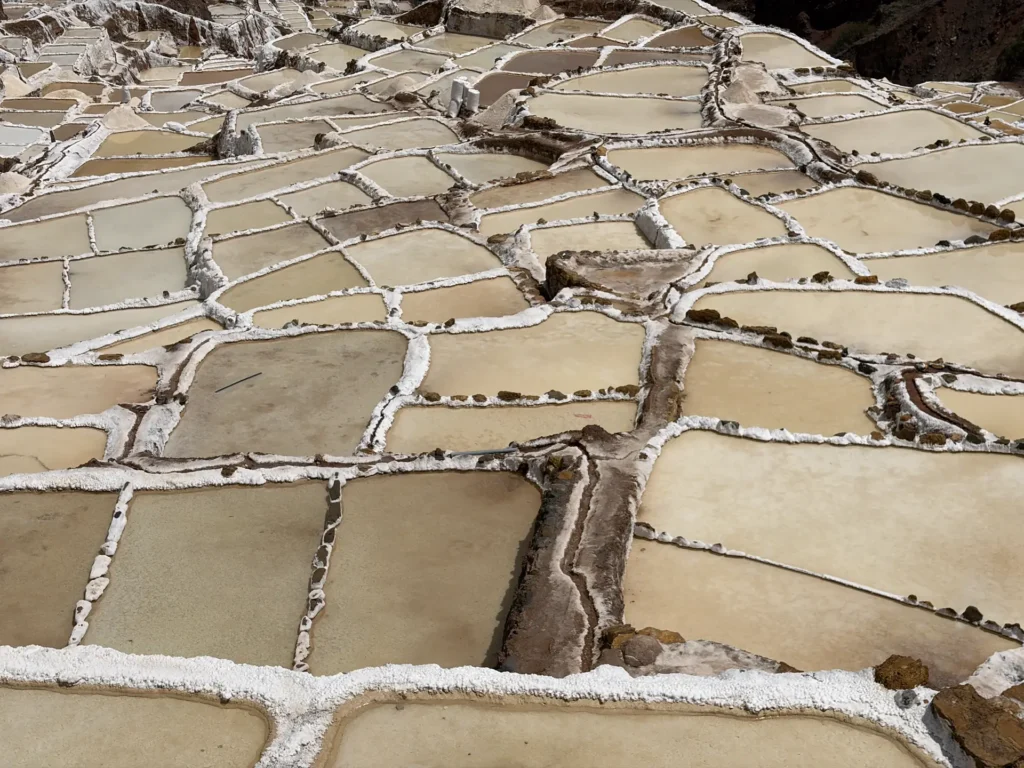
The Salt Mines lie at about 3,200 m, on the slopes of Qaqawiñay hill, above the Vilcanota valley. According to the Ministry of Culture, there are around 4,500 pools, arranged in tiers, that receive salt water from a spring through a main channel that divides into small channels, like the irrigation of the terraces. The system has worked without interruption since pre-Inca times.
Each pool is filled with about 5 cm of salt water and left to evaporate for three days; the cycle is repeated for a month, until a layer of salt 7 to 10 cm thick has formed. Each pool produces an average of 150 to 200 kg of salt per month. The salt is graded and sold by Marasal, the company of the communities of Maras and Pichingoto, and the profits are shared according to the pools each owner has.
- Heritage: it has been a Monumental Archaeological Zone since 1998 (RDN No. 604/INC), and the knowledge and techniques of salt extraction have been Cultural Heritage of the Nation since 2008. Since 2019 it has been on the UNESCO World Heritage Tentative List, and in 2024 Maras salt became Peru’s first Geographical Indication.
- No walking among the pools: since 15 June 2019, for hygiene reasons, the visit ends at the main viewpoint, because the salt is for human consumption.
Tickets and opening hours
| Ticket | Hours | |
|---|---|---|
| Moray | Cusco Tourist Ticket (Boleto Turístico): partial ticket for Circuit III, S/ 70 for foreigners (2 days) and S/ 40 for Peruvians (1 day), or the full ticket, S/ 130 and S/ 70 | 7:00 – 17:00 |
| Maras Salt Mines | Separate entrance fee, not included in the Boleto Turístico: S/ 20 for foreigners and S/ 15 for Peruvians | 9:00 – 17:00 |
The partial Circuit III ticket also includes Pisac, Chinchero and Ollantaytambo; all the tickets and their conditions are in our article Cusco Tourist Ticket 2026. The Salt Mines fee is the one announced by Marasal in 2024 and published by PromPerú in 2025, and the opening hours are those of the MINCETUR inventory: confirm them when you arrive.
The town of Maras
The Villa de San Francisco de Asís de Maras lies at about 3,375 m. Its colonial church holds religious art, with works by the painter Antonio Sinchi Roca Inka, and its main festival is that of Saint Francis of Assisi, on 4 October. In 2024, UN Tourism selected Maras as one of the world’s Best Tourism Villages.
How to get there from Cusco
- To the Maras turnoff: 43 km along the Cusco – Urubamba highway, about 70 minutes by tourist minibus. From the turnoff to the town of Maras it is about 4.5 km.
- From Maras to Moray: about 7 to 8 km, around 15 minutes.
- From Maras to the Salt Mines: 6.6 km on a gravel road, about 20 minutes by car, or 3.7 km on foot along the mule trail, about 45 minutes. You can also get there from the valley floor, through the community of Pichingoto and the Tarabamba bridge.
There is no direct public transport to the Salt Mines, according to PromPerú. The most practical option is a tour: our Maras and Moray tour (half day) includes both sites, and the Sacred Valley VIP adds them to Pisac, Chinchero and Ollantaytambo in a full day. You can also do it by ATV. Compare all the options in Sacred Valley tours from Cusco.
Best time to visit
They can be visited all year round. According to the Ministry of Culture, in the dry season (May to October) the salt builds up faster, there is more production and it comes out white or pink; in the rainy season (November to April) production is more difficult and the salt turns brown. In Urubamba, the nearest SENAMHI weather station, it hardly rains from May to September and rainfall is concentrated from December to March.
Moray is slightly higher than the city of Cusco (3,399 m): if you have just arrived, read how to acclimatize in Altitude of Machu Picchu, Cusco and the Sacred Valley.
Tips for your visit
- Bring your ID along with the Boleto Turístico, which is issued in your name, and Peruvian soles for the Salt Mines entrance fee.
- At Moray, stay on the marked paths. As in all archaeological parks, you may not bring in food, climb on the walls or fly drones without authorization from DDC Cusco.
- Bring sunscreen, a cap and a light jacket.
- Moray has level access up to the entrance; inside the site and at the Salt Mines there are slopes and stairs.
To see these sites together with the rest of the valley, read our guide to the Sacred Valley of the Incas.
Official sources (checked in October 2026):
- Moray (description, altitude, opening hours, heritage declaration, access and rules): DDC Cusco. Tourism inventory: MINCETUR, Moray, Salt Mines and Town of Maras.
- Visitors: MINCETUR (2025) and Ministry of Culture, Cultura en Números, first quarter 2026.
- Salt Mines (pools, production, seasons and heritage declarations): Ministry of Culture, Tentative List form. Fee and transport: PromPerú and Andina. Ban on entering the pools: Andina. Geographical Indication: Andina.
- Boleto Turístico: COSITUC. Urubamba climate: SENAMHI, Climate Normals 1991–2020. Best Tourism Villages 2024: Andina.
Frequently asked questions
How much is the entrance fee to the Maras Salt Mines?
S/ 20 for foreigners and S/ 15 for Peruvians, according to the fee announced by Marasal in 2024 and published by PromPerú. It is not included in the Cusco Tourist Ticket (Boleto Turístico). Confirm it at the ticket office.
Which ticket do I need to enter Moray?
The Cusco Tourist Ticket (Boleto Turístico): the partial Circuit III ticket (S/ 70 for foreigners, S/ 40 for Peruvians), which also includes Pisac, Chinchero and Ollantaytambo, or the full ticket (S/ 130 and S/ 70).
Can you walk among the salt pools?
No. Since 15 June 2019, entering the pools has not been allowed for hygiene reasons, because the salt is for human consumption. The visit goes as far as the viewpoint.
What was Moray used for?
The Cusco Directorate of Culture describes it as an Inca agricultural experimentation center that took advantage of the different ecological zones of its terraces. It may also have had a ceremonial function, and its specific function is still being researched.
How far are Maras and Moray from Cusco?
The Maras turnoff is 43 km from Cusco along the road to Urubamba, about 70 minutes. From Maras it is about 7 to 8 km to Moray and 6.6 km to the Salt Mines.
How many salt pools are there in Maras?
Around 4,500, according to the Ministry of Culture. Each one produces an average of 150 to 200 kg of salt per month.
What is the best time to visit the Salt Mines?
From May to October, in the dry season, there is more production and the salt is white or pink. From November to April, with the rains, production is more difficult and the salt looks brown.