

Ollantaytambo lies at the end of the Sacred Valley, 61 km from Cusco via Chinchero and at an altitude of 2,860 m (9,383 ft). It is two things at once: an Inca archaeological park, with terraces and the Temple of the Sun high on the hill, and a town that is still inhabited on its Inca layout. The train to Machu Picchu leaves from its station. The park is covered by the Cusco Tourist Ticket (Boleto Turístico), and two nearby sites, Pinkuylluna and Inti Punku, are free to enter. Here is what to see, tickets, opening hours and how to get there.
Data as of 24 October 2026. The opening hours, altitude and distances are those of the Decentralized Directorate of Culture of Cusco (DDC). The official sources for every figure are listed at the end of the article.
- 2,860 maverage altitude of the archaeological park (9,383 ft)
- 7:00 – 16:30park opening hours, every day
- 1 h 30 minby train to Machu Picchu Pueblo, according to PeruRail

What Ollantaytambo is
According to DDC Cusco, Ollantaytambo was a planned city of the Inca State, built as a residence for the nobility. The chronicler Sarmiento de Gamboa attributes its construction to Pachacútec, and Garcilaso de la Vega to Wiracocha. The tambos in the area were a waypoint on the way to the jungle. According to the MINCETUR tourism inventory, it combined military, religious, administrative and agricultural functions, and the work was left unfinished with the war between Huáscar and Atahualpa and the arrival of the Spanish.
During the conquest it was the refuge of Manco Inca: in January 1537 his troops defeated those of Hernando Pizarro here, taking advantage of the terrain and the Vilcanota River, and he then withdrew to Vilcabamba, according to the Ministry of Culture. The name is thought to come from Ollanta, an Inca general, and tampu, lodging or inn: “the lodging of Ollanta”. That general is the protagonist of the Ollantay drama, an anonymous play about his love for a daughter of Pachacútec; it is a theatrical legend, not a historical fact.
It is Cultural Heritage of the Nation (Law 23765, of 1983). The archaeological park, declared by National Directorial Resolution No. 395-2002, covers 34,800 hectares; the monumental zone that is visited covers some 18 hectares, according to the Ministry of Culture.
What to see in the archaeological park
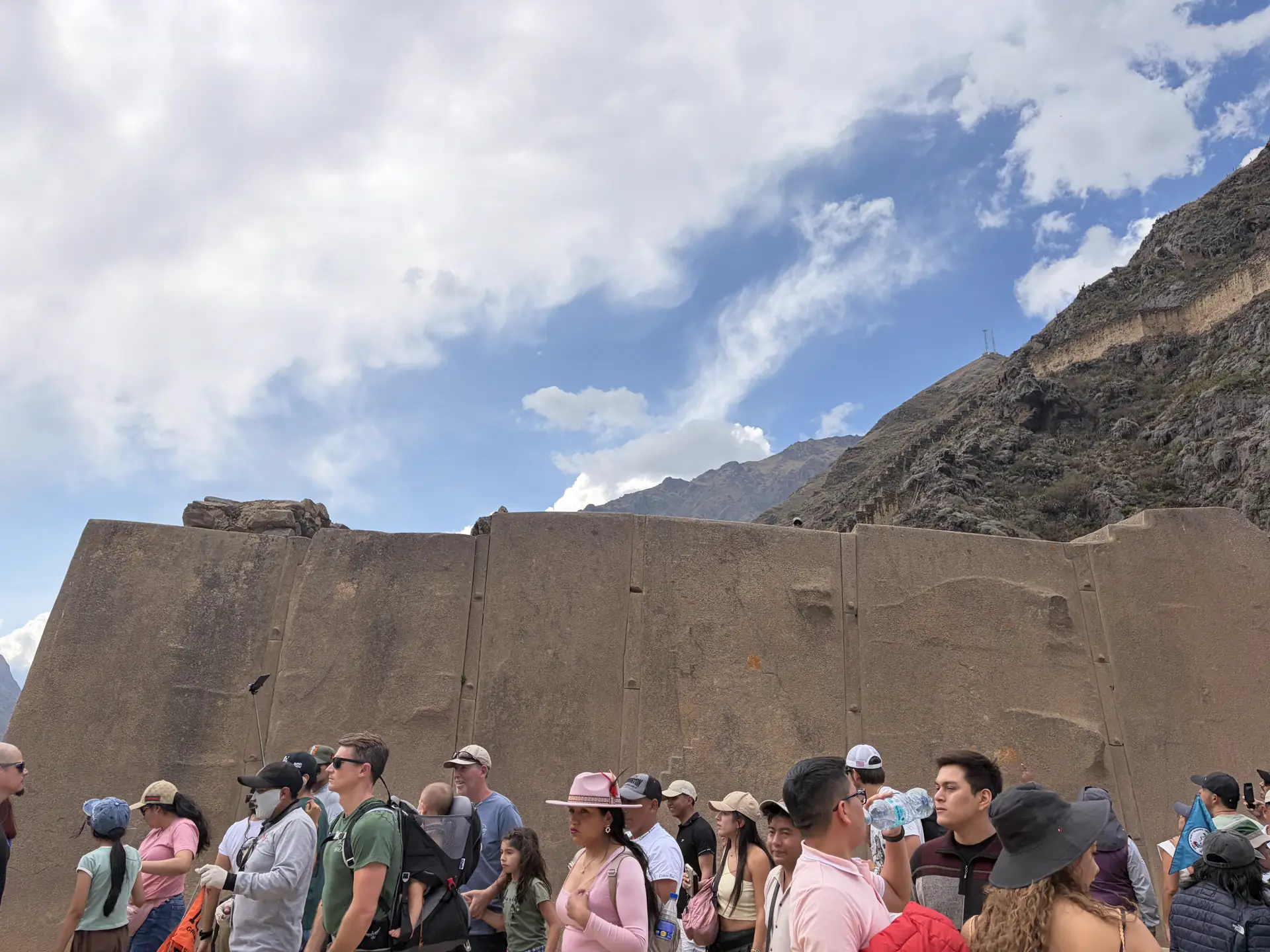
The DDC divides the park into two sectors: Qosqo Ayllu, the urban sector, with enclosures and the ceremonial complex, and Araccama Ayllu, the one usually called “the fortress”, with terraces, enclosures and the structure of the six monoliths. The main route is a stone stairway that climbs, in about 20 to 30 minutes, to the Enclosure of the Ten Niches (Diez Hornacinas) and the Temple of the Sun.
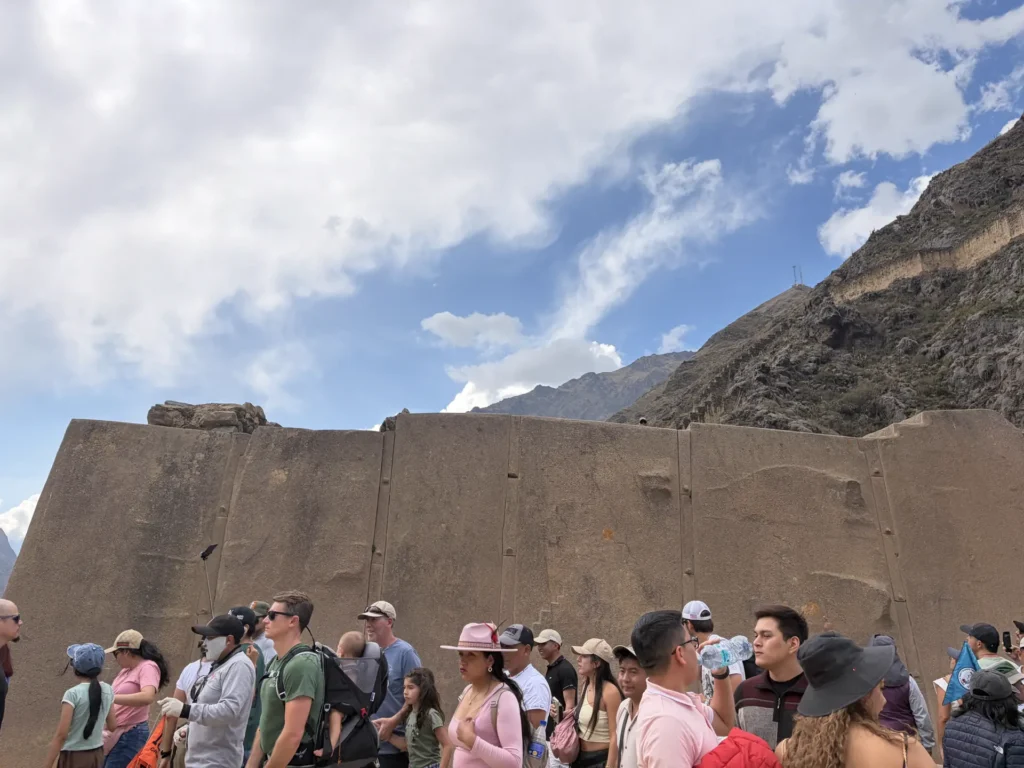
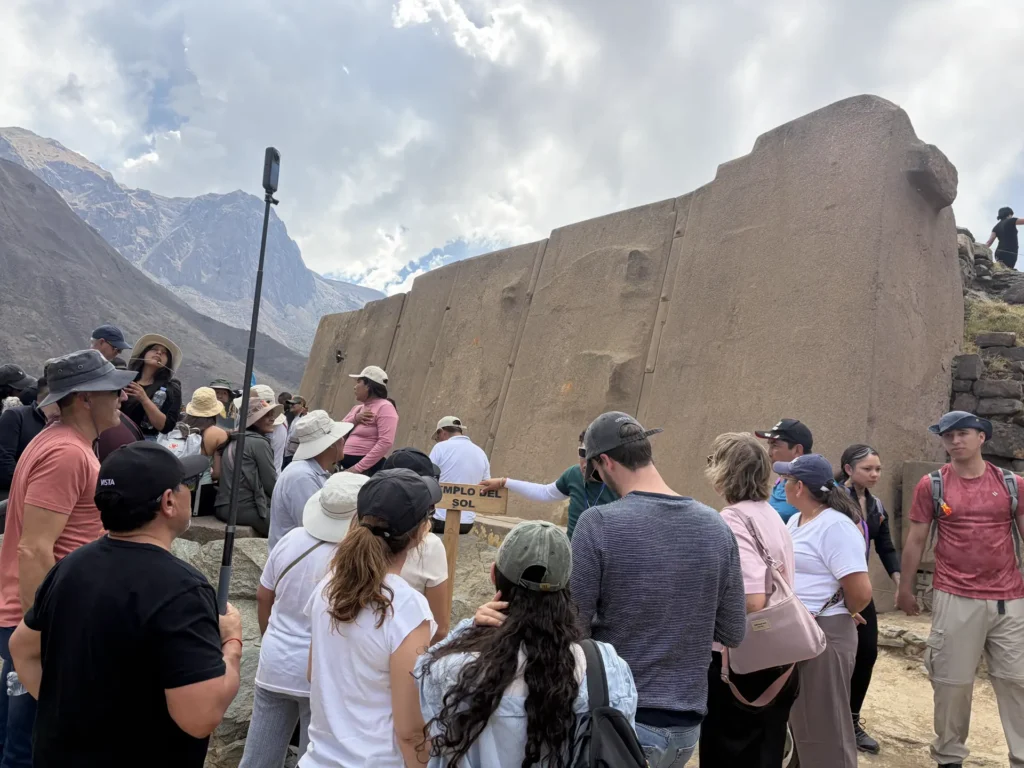
- Temple of the Sun and Wall of the Six Monoliths: six blocks of pink stone between 3.3 and 4.2 m high, facing the sunrise, with carved chakanas. The stones were brought from the Cachiccata quarries, about 4 km away, and the temple was never finished, according to the Ministry of Culture.
- Terraces: the large terraces that climb the hill up to the Temple of the Sun.
- Baño de la Ñusta (Bath of the Princess) and fountains: stone fountains, some ritual and others for daily use; at the Baño de la Ñusta the water flows all year round.
- Other sectors: the Ministry of Culture also mentions the Temple of Water, the Ceremonial Fountain, the pre-Inca sector, the Inca Misana, the qolqas (storehouses), the Inka Watana and the military zone.
According to MINCETUR, Ollantaytambo shows clearly how the Incas built: at the site you can see stones at different stages of extraction, carving, transport and assembly.
The Inca town that is still inhabited
Below the park lies the town. Its neighborhoods of Inca origin, Qosqo Ayllu and Araccama Ayllu, are preserved and still in use, according to the MINCETUR tourism inventory; that is why it is called a “living Inca town”. It is worth walking its streets before or after your visit to the park.
In 2021, UN Tourism selected Ollantaytambo as one of the world’s Best Tourism Villages, the only one in Peru that year. In 2022 MINCETUR recognized it as the country’s first Pueblo con Encanto (Town with Charm), and in 2025 it gave it Jerarquía 4, the highest rating it gives a tourism resource.

Pinkuylluna and Inti Punku: two free visits
- Pinkuylluna: on the hill of the same name, east of the town, you can see the Inca storehouses (qolqas): two-level buildings with cooling ducts, according to MINCETUR. It is about 300 m from the town, some 20 minutes on foot. Free entry, from 7:30 to 16:30.
- Inti Punku (Gate of the Sun): an Inca stone gateway at 3,885 m (12,746 ft), which MINCETUR describes as an astronomical and strategic viewpoint, with views of the snow-capped La Verónica. Free entry, from 6:00 to 17:00. It is a long, demanding hike from the valley: ask about access in town before you go.
Tickets and opening hours
| Ticket | Hours | |
|---|---|---|
| Ollantaytambo Archaeological Park | Cusco Tourist Ticket (Boleto Turístico): partial ticket for Circuit III, S/ 70 for foreigners (2 days) and S/ 40 for Peruvians (1 day), or the full ticket, S/ 130 for foreigners and S/ 70 for Peruvians (10 days) | 7:00 – 16:30 |
| Pinkuylluna | Free | 7:30 – 16:30 |
| Inti Punku | Free | 6:00 – 17:00 |
There is no individual ticket for Ollantaytambo: the partial Circuit III ticket also includes Pisac, Chinchero and Moray, and the ticket is sold at the park entrance. There are student fares: all the tickets and their conditions are in our article Cusco Tourist Ticket 2026. These are the COSITUC fares in force in October 2026; the regulation of the new Tourist Ticket Law (Law 32586) is still under consultation, so they could change.
How to get there from Cusco
- By road: there are two paved routes, via Chinchero and Urubamba (61 km, approximately 1 h 30 min) or via Pisac, Calca and Urubamba (92 km). That is why many tours enter the valley on one side and return on the other.
- By train: PeruRail departs from Poroy station, in Cusco, and takes approximately 1 h 40 min to Ollantaytambo.
- Public transport: there are colectivos (shared vans) and minibuses from Cusco to Urubamba and Ollantaytambo. We do not publish fares because there is no updated official data.
Roadworks in the historic center (2026). Since 13 April 2026, and for about eight months according to PromPerú and PeruRail, vehicle traffic has been restricted in the historic center because of municipal works. Vehicles reach the district and the station via the Araccama – Rumira section, and PromPerú recommends allowing 15 to 20 extra minutes in low season and 30 to 45 extra minutes in high season to get to the train.
The most practical option is a tour with transport and a guide: the Classic Sacred Valley and the Sacred Valley VIP include Ollantaytambo in a full day from Cusco. Compare all the options in Sacred Valley tours from Cusco.
Ollantaytambo and the train to Machu Picchu
Ollantaytambo is the main departure station for Machu Picchu Pueblo (Aguas Calientes): PeruRail and Inca Rail depart from here, and the journey takes approximately 1 h 30 min, according to PeruRail. Inca Rail asks passengers to arrive at the station at least 30 minutes before departure. The train options, timetables and routes are in how to get to Machu Picchu from Cusco.
You can make the most of the trip to see Ollantaytambo before boarding the train: our 2-day Sacred Valley and Machu Picchu tour travels through the valley, visits the Ollantaytambo park with a guide and continues by train to Aguas Calientes. If you only want to go to Machu Picchu in a day, the Machu Picchu Full Day by train also departs from this station.
When to go and festivals
Ollantaytambo can be visited all year round. In Urubamba, the nearest SENAMHI weather station, it hardly rains from May to September and rainfall is concentrated from December to March. It is one of the most visited sites in Cusco: it received 543,837 visitors in 2023, according to MINCETUR, and the Ministry of Culture estimates up to about 3,700 visits a day in high season, from June to December. If you want to explore it with fewer people, arrive early.
According to the MINCETUR tourism inventory, the main festivals are the Bajada de Reyes, the Niño Melchor de Marcacocha (February), the Señor de Choquekillka (between May and June; the date changes every year) and the Ollantay Raymi, on 29 June, when the Ollantay drama is performed in the archaeological park.
Tips for your visit
- Allow about 2 hours in the park, the average visit time according to the Ministry of Culture.
- The climb to the Temple of the Sun is up stone stairways. If you prefer not to climb, there is a short, flat circuit of about 35 minutes, and the entrance has a ramp for people with disabilities (DDC).
- Bring your ID along with the Boleto Turístico, which is issued in your name.
- The DDC does not allow you to enter with food, alcoholic drinks or animals, to climb or paint the walls, to camp, or to fly drones or film for commercial purposes without its authorization.
- Ollantaytambo is about 540 m (1,772 ft) lower than the city of Cusco, at 3,399 m (11,152 ft): if you have just arrived, read how to acclimatize in Altitude of Machu Picchu, Cusco and the Sacred Valley.
To see Ollantaytambo together with Pisac, Chinchero, Maras and Moray, read our guide to the Sacred Valley of the Incas.
Official sources (checked in October 2026):
- Archaeological park (sectors, history, altitude, opening hours, heritage declaration, access, rules and short circuit): DDC Cusco. MINCETUR tourism inventory: Ollantaytambo Archaeological Park, Town of Ollantaytambo, Pinkuylluna and Intipunku.
- Sectors, Temple of the Sun, Cachiccata quarries, the 1537 battle and daily visits: Ministry of Culture, quoted by Andina (October 2024).
- Recognitions: UN Tourism, Best Tourism Villages 2021, MINCETUR, first Pueblo con Encanto and Jerarquía 4.
- Boleto Turístico: COSITUC and El Peruano (Law 32586 regulation).
- Roadworks and access 2026: PromPerú and PeruRail. Trains: PeruRail and Inca Rail. Urubamba climate: SENAMHI, Climate Normals 1991–2020.
Frequently asked questions
How much is the entrance fee to Ollantaytambo?
You enter with the Cusco Tourist Ticket (Boleto Turístico): the partial Circuit III ticket costs S/ 70 for foreigners (2 days) and S/ 40 for Peruvians (1 day), and also includes Pisac, Chinchero and Moray. The full ticket costs S/ 130 and S/ 70 (10 days). There is no individual ticket. These are COSITUC fares as of October 2026.
What are the opening hours of the Ollantaytambo Archaeological Park?
From 7:00 to 16:30, every day, according to the Decentralized Directorate of Culture of Cusco.
What is there to see in Ollantaytambo?
The archaeological park, with its terraces, the Temple of the Sun and the Wall of the Six Monoliths, and the Baño de la Ñusta; the Inca town that is still inhabited; and, for free, the Pinkuylluna storehouses and the Inti Punku gateway.
How much time do you need to visit Ollantaytambo?
About 2 hours for the archaeological park, according to the Ministry of Culture. If you also want to climb Pinkuylluna and walk around the town, allow more time.
How long does it take to get from Cusco to Ollantaytambo?
Approximately 1 h 30 min by road, via the Chinchero route (61 km). The route via Pisac is 92 km. By train, from Poroy station, it takes about 1 h 40 min.
Is entry to Pinkuylluna free?
Yes. According to the MINCETUR tourism inventory, entry to Pinkuylluna is free, from 7:30 to 16:30. It is about 20 minutes on foot from the town.
How long is the train from Ollantaytambo to Machu Picchu?
Approximately 1 h 30 min to Machu Picchu Pueblo (Aguas Calientes), according to PeruRail. From there you go up to the citadel by bus or on foot.