

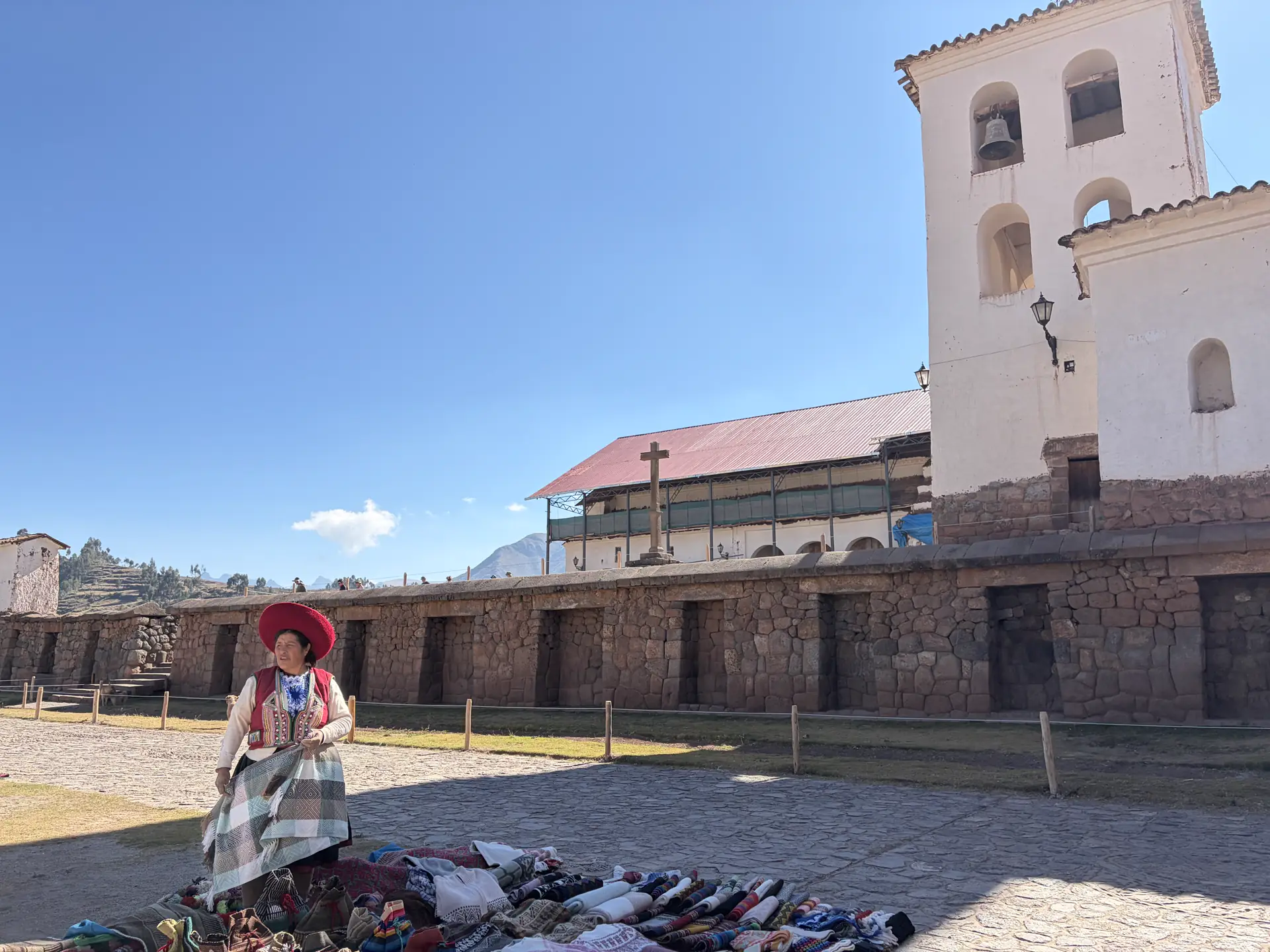
Chinchero is 30 km from Cusco, on the road to Urubamba, at an altitude of 3,750 m (12,303 ft). It was a residence of the Inca nobility built during the rule of Túpac Yupanqui, and a colonial church with mural paintings was raised on the walls of its palace. Its terraces still stand next to the town, which keeps a strong weaving tradition and holds a market on Sundays. The park is covered by the Cusco Tourist Ticket (Boleto Turístico). Here is what to see, tickets, opening hours and how to get there.
Data as of 24 October 2026. The opening hours, altitude and distance are those of the Decentralized Directorate of Culture of Cusco (DDC). The official sources for every figure are listed at the end of the article.
- 3,750 maverage altitude of the archaeological park (12,303 ft)
- 7:00 – 18:00park opening hours, every day
- 30 kmfrom Cusco, on a paved road
What Chinchero is
According to DDC Cusco, the Inca palaces of Chinchero were built during the rule of the Inca Túpac Yupanqui as a residence for the elite, linked to the apus (sacred mountains) Salkantay, Verónica and Soraq. The historian Luis E. Valcárcel dates the great royal palace to around 1480. Before the Incas, the area was already occupied by the Killke culture. There are two hypotheses for its name, according to MINCETUR: chinchay, an Andean feline, or sincheraq, “the powerful one”.
The archaeological park, covering 43.10 hectares, is Cultural Heritage of the Nation (National Directorial Resolution No. 405-2002), and the town has been a monumental zone since 1972.
What to see in the archaeological park
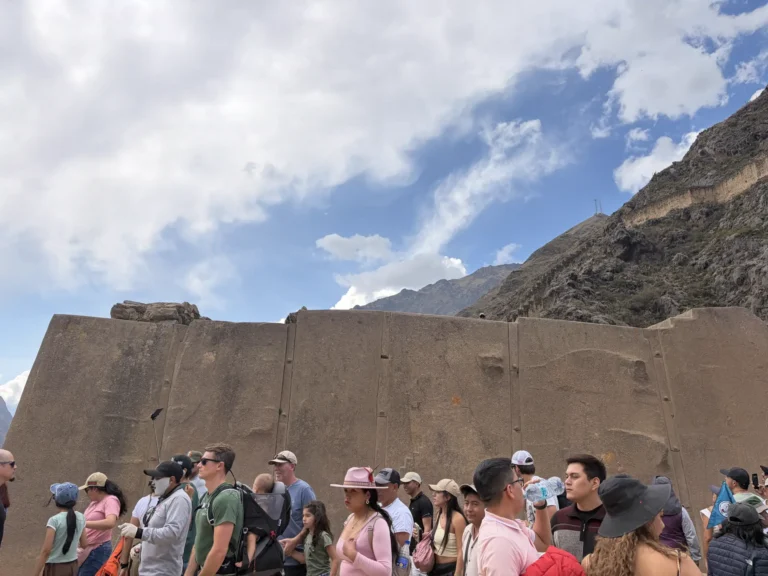
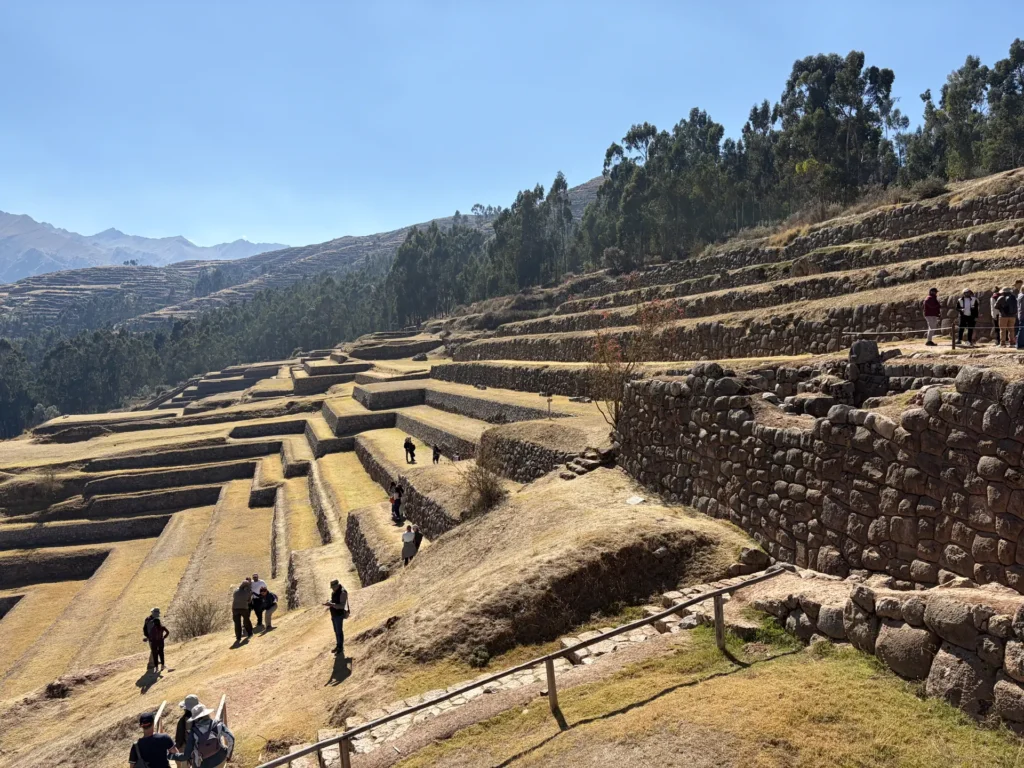
The DDC describes a complex of pre-Hispanic paths, enclosures, terraces, water channels, huacas (sacred places) and shrines, built with large stone blocks and adapted to the terrain. It has two sectors:
- Urban sector: the residential and ceremonial enclosures of the nobility. According to MINCETUR, it includes the Capellanpampa square, the Guaca de la Virgen Natividad and the colonial house of Mateo Pumacahua.
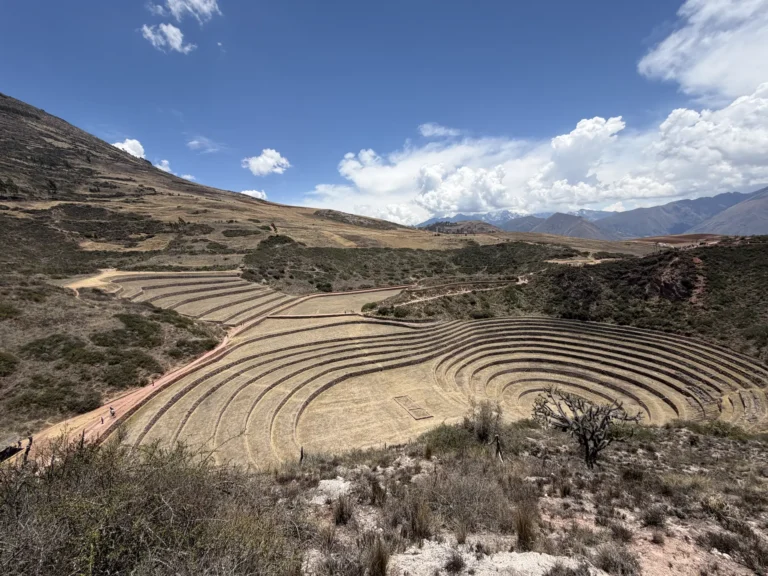
- Agricultural sector: the terraces that descend the hillside, with names such as Patapatayoq, Yanaqaqa, Munaypata, Quillapata or Condorqaqa. MINCETUR also mentions the Waca Sucanca, next to an Inca canal that connects with Lake Piuray.
According to the MINCETUR inventory, it was a place of rest and of worship of the sun, water and the mountains, and sunlight marked the sowing and harvest seasons. From the town square you reach the entrance on level ground, and from there you can see the whole monumental zone (DDC).
The colonial church of Chinchero
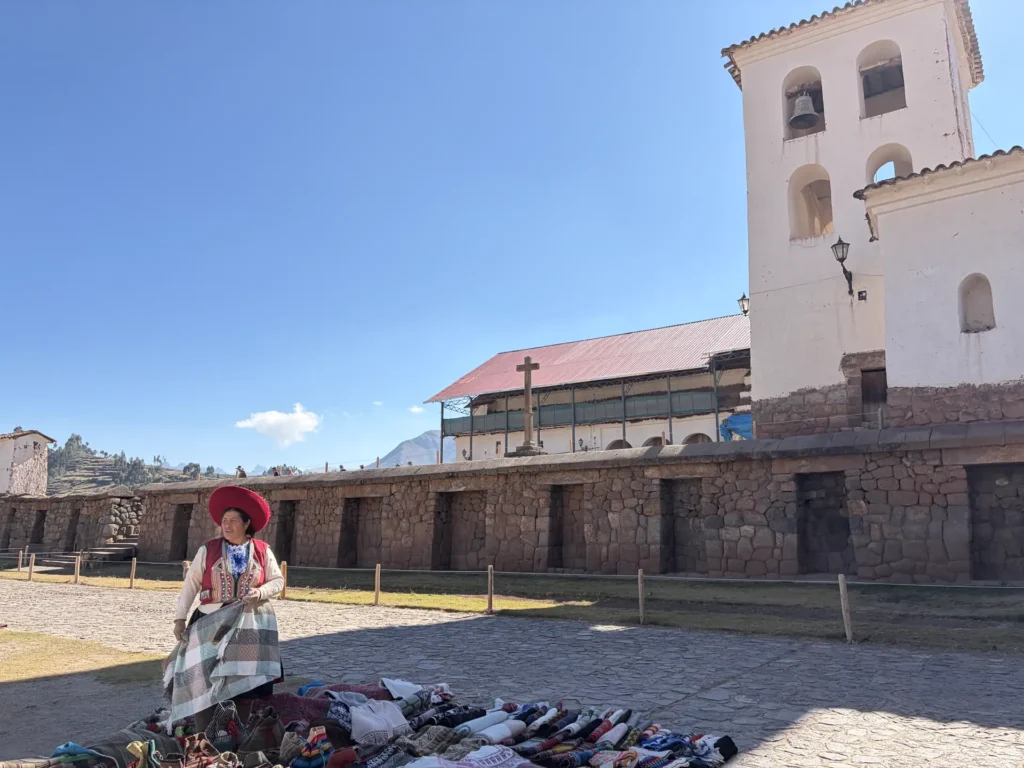
The church of Nuestra Señora de la Natividad (Our Lady of the Nativity), at first called Nuestra Señora de Monserrat, was completed in 1607 on the Inca walls of the palace of Túpac Yupanqui, which serve as its foundation. According to MINCETUR:
- Its walls and ceiling are covered in mural paintings, and its baroque high altar has gold leaf, mirrors and silver plates.
- It holds a large canvas of the Virgin of Monserrat with a view of the town, painted in 1693 by Francisco Chihuantito.
- On the entrance portal there are murals of the procession of the cacique Pumacahua and the defeat of Túpac Amaru: Mateo Pumacahua, cacique (chief) of Chinchero, sided with the Crown during the rebellion of Túpac Amaru II.
It has been a Historic and Artistic Monument since 1972 and is administered by the District Municipality of Chinchero: check the opening hours and entry conditions on site. Opposite the church, on the square, is the Chinchero Site Museum (Museo de Sitio de Chinchero), with ceramics, metalwork, farming and weaving tools, and a stone block carved in the shape of a puma; check its opening hours on site.
Textiles and the Sunday market
The DDC highlights the textile art of Chinchero: its weavings keep symbols of Inca culture and use natural dyes. According to PromPerú, its master weavers follow an ancestral tradition, and some workshops welcome visitors to show how they spin, dye and weave.
On Sundays the traditional market is held, where the textiles and crafts of the district are sold. According to MINCETUR, barter, called chalay, is still practised, especially among older people.
In 2025, the Ministry of Culture declared the system of traditional authorities of Chinchero, the Varayoq, Cultural Heritage of the Nation; they are still active in the district.
Surroundings: lakes and a waterfall
- Lake Piuray (3,435 m / 11,270 ft): one of the water sources of the city of Cusco since Inca times, 1 km from the Cusco – Chinchero road. Free entry, from 7:00 to 16:00.
- Lake Huaypo (3,460 m / 11,352 ft): 10 km along a dirt road from the Chinchero turn-off. Free entry, from 7:00 to 17:00.
- Poq Poq Waterfall: a 3.5 km hike, approximately 1 hour, from the craft market, partly along a section of the Qhapaq Ñan (the Inca road network). The community of Cuper charges an entrance fee.
Our Pachamanca tour, a culinary experience in the Sacred Valley, also starts in the district of Chinchero.
Tickets and opening hours
| Ticket | Hours | |
|---|---|---|
| Chinchero Archaeological Park | Cusco Tourist Ticket (Boleto Turístico): partial ticket for Circuit III, S/ 70 for foreigners (2 days) and S/ 40 for Peruvians (1 day), or the full ticket, S/ 130 for foreigners and S/ 70 for Peruvians (10 days) | 7:00 – 18:00 |
| Colonial church | Administered by the Municipality of Chinchero: confirm on site | Check on site |
| Lake Piuray | Free | 7:00 – 16:00 |
| Lake Huaypo | Free | 7:00 – 17:00 |
There is no individual ticket for Chinchero: the partial Circuit III ticket also includes Pisac, Moray and Ollantaytambo. There are student fares: all the tickets and their conditions are in our article Cusco Tourist Ticket 2026. These are the COSITUC fares in force in October 2026; the regulation of the new Tourist Ticket Law (Law 32586) is still under consultation, so they could change.
How to get there from Cusco
Chinchero is 30 km from Cusco along the paved road to Urubamba, about 35 minutes by car according to MINCETUR (longer with traffic). From the town square to the park it is about 200 m, 5 minutes on foot. There are combis (minibuses) and taxis from Cusco; we do not publish fares because there is no updated official data.
As it is on the way to the valley, almost every tour passes through here: the Classic Sacred Valley ends in Chinchero and the Sacred Valley VIP starts here. Our Maras and Moray tour stops at the Chinchero craft market on the way to Maras: Moray and the Salineras (salt pans) are visited from the Maras turn-off, on the same road (see Maras and Moray). Compare all the options in Sacred Valley tours from Cusco.
Chinchero airport
The Ministry of Transport and Communications (MTC) is building Chinchero International Airport. In June 2026, the MTC’s Directorate General of Civil Aeronautics stated that the works would be completed in the second half of 2028 and that operations would begin in 2029, if the schedule is met. Meanwhile, flights continue to arrive at Alejandro Velasco Astete airport, in the city of Cusco.
Festivals in Chinchero
- Virgen de la Natividad (Virgin of the Nativity), the patron saint: from 7 to 10 September, with more than 12 dances, Mass and a procession.
- Corpus Christi: the date changes every year; the procession of more than ten saints is led by the Virgen de la Natividad.
- Mujun Muyuy (boundary marking), in February: the peasant communities walk and mark the boundaries of their lands.
The dates and descriptions are those of the MINCETUR tourism inventory.
Tips for your visit
- Chinchero is about 350 m (1,148 ft) higher than the city of Cusco, at 3,399 m (11,152 ft): if you have just arrived, walk slowly and read how to acclimatize in Altitude of Machu Picchu, Cusco and the Sacred Valley.
- Bring your ID along with the Boleto Turístico, which is issued in your name, and cash in soles if you plan to buy textiles.
- The site coexists with the town: respect the signposted areas. The DDC does not allow you to enter with food, alcoholic drinks or animals, to climb or paint the walls, to camp, or to fly drones or film for commercial purposes without its authorization.
- Bring a light jacket, a cap and sunscreen.
To see Chinchero together with Pisac, Ollantaytambo, Moray and Maras, read our guide to the Sacred Valley of the Incas.
Official sources (checked in October 2026):
- Archaeological park (history, sectors, altitude, opening hours, heritage declaration, access and rules): DDC Cusco, Chinchero Archaeological Park and information sheet (2021).
- MINCETUR tourism inventory: archaeological park, colonial church, site museum, traditional market, Lake Piuray, Lake Huaypo, Poq Poq Waterfall and festivals (Virgen de Natividad, Corpus Christi, Mujun Muyuy).
- Textiles: PromPerú. Varayoq: El Peruano, R.VM. No. 000075-2025-VMPCIC/MC. Mateo Pumacahua: Congress of the Republic, La rebelión de Túpac Amaru II.
- Boleto Turístico: COSITUC and El Peruano (Law 32586 regulation). Airport: the MTC’s Directorate General of Civil Aeronautics, quoted by Correo (June 2026).
Frequently asked questions
How much is the entrance fee to Chinchero?
You enter with the Cusco Tourist Ticket (Boleto Turístico): the partial Circuit III ticket costs S/ 70 for foreigners (2 days) and S/ 40 for Peruvians (1 day), and also includes Pisac, Moray and Ollantaytambo. The full ticket costs S/ 130 and S/ 70 (10 days). There is no individual ticket. These are COSITUC fares as of October 2026.
What are the opening hours of the Chinchero Archaeological Park?
From 7:00 to 18:00, every day, according to the Decentralized Directorate of Culture of Cusco. The opening hours of the colonial church are set by the municipality: confirm them on site.
What is there to see in Chinchero?
The terraces and enclosures of the archaeological park, the colonial church of Nuestra Señora de la Natividad with its mural paintings, the site museum, the textiles with natural dyes and the Sunday market. Nearby are Lakes Piuray and Huaypo, which are free to enter.
When is the Chinchero market?
The traditional market is held on Sundays, with textiles and crafts from the district. According to MINCETUR, barter, called chalay, is still practised.
How far is Chinchero from Cusco?
30 km along the paved road to Urubamba, about 35 minutes by car. It is one of the stops on Sacred Valley tours.
What is the altitude of Chinchero?
The archaeological park is at an average altitude of 3,750 m (12,303 ft), according to DDC Cusco: about 350 m (1,148 ft) higher than the city of Cusco.
When will Chinchero airport open?
According to the MTC's Directorate General of Civil Aeronautics (June 2026), the works would be completed in the second half of 2028 and operations would begin in 2029, if the schedule is met. Today flights arrive at the airport in the city of Cusco.